E-posta: satış@mill-sbm.com

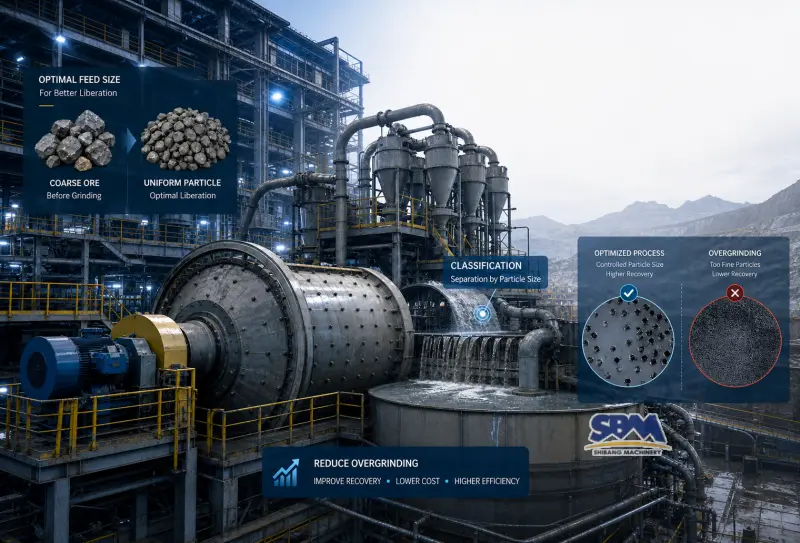
Overgrinding in metal ore processing reduces recovery, increases energy consumption, and creates unnecessary fine particles that are harder to separate. The best way to reduce overgrinding is to control feed size, improve classification efficiency, stabilize mill operation, and match grind size to the actual needs of downstream recovery.
What Is Overgrinding in Metal Ore Processing?
Overgrinding happens when ore particles stay in the grinding circuit longer than necessary and become finer than the target size. This usually creates excess slimes and ultra-fine particles that do not improve liberation but can reduce flotation, manyetik ayrılık, or leaching performance.
Birçok bitkide, overgrinding is not caused by one machine alone. It is often the result of poor feed consistency, weak classification, unstable circulating load, or a mismatch between the grinding target and the actual recovery process.
Why Overgrinding Hurts Recovery?
Many operators assume finer grinding always leads to better liberation. pratikte, grinding too fine can damage overall process efficiency.
Overgrinding can cause several problems:
- It increases energy use without creating proportional recovery gains.
- It generates excess fines that are harder to recover in downstream separation.
- It can overload hydrocyclones or other classification equipment.
- It may increase reagent consumption in flotation circuits.
- It can reduce throughput by keeping material in the circuit too long.
The goal is not the finest possible product. The goal is the Sağ product size for recovery.
Common Causes of Overgrinding
Overgrinding usually starts upstream or in circuit control rather than in the mill itself.
The most common causes include:
- Inconsistent feed size from the crushing stage.
- Poor classification efficiency.
- High circulating load with weak control.
- Incorrect mill speed, media charge, or residence time.
- Chasing finer grind size without test data.
- Ore variability that is not reflected in operating adjustments.
This is why grinding should always be evaluated as part of the whole process, not as an isolated stage.
How to Reduce Overgrinding?
Control feed size before grinding
A stable feed helps the mill operate more predictably. If the crushing stage sends irregular or overly fine material into the mill, the circuit becomes harder to control and more likely to produce excess fines.
Plants should first confirm that the metal cevheri kırma işlemi is delivering a consistent product for the grinding stage. Good upstream control often solves part of the overgrinding problem before it reaches the mill.
Improve classification efficiency
Classification is one of the most important tools for reducing overgrinding. When classification works properly, fine particles leave the circuit at the right time and coarse particles return for further grinding.
When classification is poor, material that is already fine enough may continue circulating through the mill. That increases power use and creates more unwanted slimes.
Match grind size to recovery needs
Do not set a grind target based only on habit or legacy plant settings. The target grind should be based on ore testing, liberation data, and downstream separation results.
In some ores, a slightly coarser product delivers nearly the same recovery with lower energy cost. In others, finer grinding may be necessary. The key is to identify the grind size that gives the best economic result, not simply the finest product.
Stabilize mill operating conditions
Unstable mill feed, changing water addition, and inconsistent media charge can all increase overgrinding risk. A stable circuit is easier to optimize and less likely to produce unnecessary fines.
Operators should monitor:
- Feed rate.
- Mill power draw.
- Water balance.
- Circulating load.
- Product particle size.
- Classification performance.
Small operating changes can gradually shift the circuit away from the target grind if they are not tracked carefully.
Review ore variability
Ore properties often change across the deposit. Sertlik, nem, kil içeriği, and mineral association can all affect grinding behavior.
If operating parameters stay fixed while ore characteristics change, the circuit may overgrind one ore type and undergrind another. Regular ore testing and plant feedback are essential for keeping the circuit aligned with real operating conditions.
Practical Signs Your Plant May Be Overgrinding
Many plants do not identify overgrinding immediately because the mill appears to be working normally. The warning signs usually appear in plant performance rather than in obvious mechanical failure.
Typical signs include:
- Recovery falls even though grind size is getting finer.
- Power consumption rises without a matching increase in throughput.
- Fine slimes increase in downstream separation.
- Classification equipment becomes less efficient.
- Reagent use increases in flotation.
- Final product quality becomes less stable.
If these signs appear together, overgrinding should be one of the first issues to investigate.
How SBM Approaches Overgrinding Reduction?
SBM'de, overgrinding is treated as a circuit problem rather than only a mill problem. A practical review usually starts with the full process path, including crushing consistency, mill selection, classification performance, and the target liberation size needed for recovery.
For projects reviewing grinding equipment choices, the metal ore grinding mill guide can help align mill selection with ore hardness, incelik, and capacity goals. If the plant is analyzing liberation and full circuit behavior, the mineral grinding process article provides a broader view of how grinding performance affects recovery.
If your plant is already focused on circuit performance, you can also review grinding circuit optimization strategies to reduce energy waste and improve throughput. For iron ore operations, the guide on iron ore crushing equipment selection is also useful when upstream feed conditions affect grinding stability.
Final Process View
Reducing overgrinding is not about making the circuit coarser at all costs. It is about producing the particle size that maximizes recovery and minimizes wasted energy.
The best results usually come from four combined actions: stable feed, efficient classification, realistic grind targets, and continuous review of ore behavior. When those factors are aligned, the grinding circuit becomes more efficient and the entire plant performs better.
SSS
What is overgrinding in metal ore processing?
Overgrinding happens when ore is ground finer than necessary for effective mineral recovery. It usually increases fines, enerji kullanımı, and process inefficiency.
Why is overgrinding bad for recovery?
Overgrinding creates excess fine particles that may be harder to recover in flotation, manyetik ayrılık, veya süzme. It can also raise energy and reagent costs.
What is the most common cause of overgrinding?
Poor classification is one of the most common causes because fine particles stay in the circuit too long instead of leaving at the correct size.
Can improving crushing reduce overgrinding?
Evet. A more stable crushing product helps the grinding circuit work more consistently and reduces the chance of generating unnecessary fines.
How do I know the right grind size for my ore?
The right grind size should be based on ore testing, liberation analysis, and downstream recovery performance rather than assumptions or habit.