Email: [email protected]

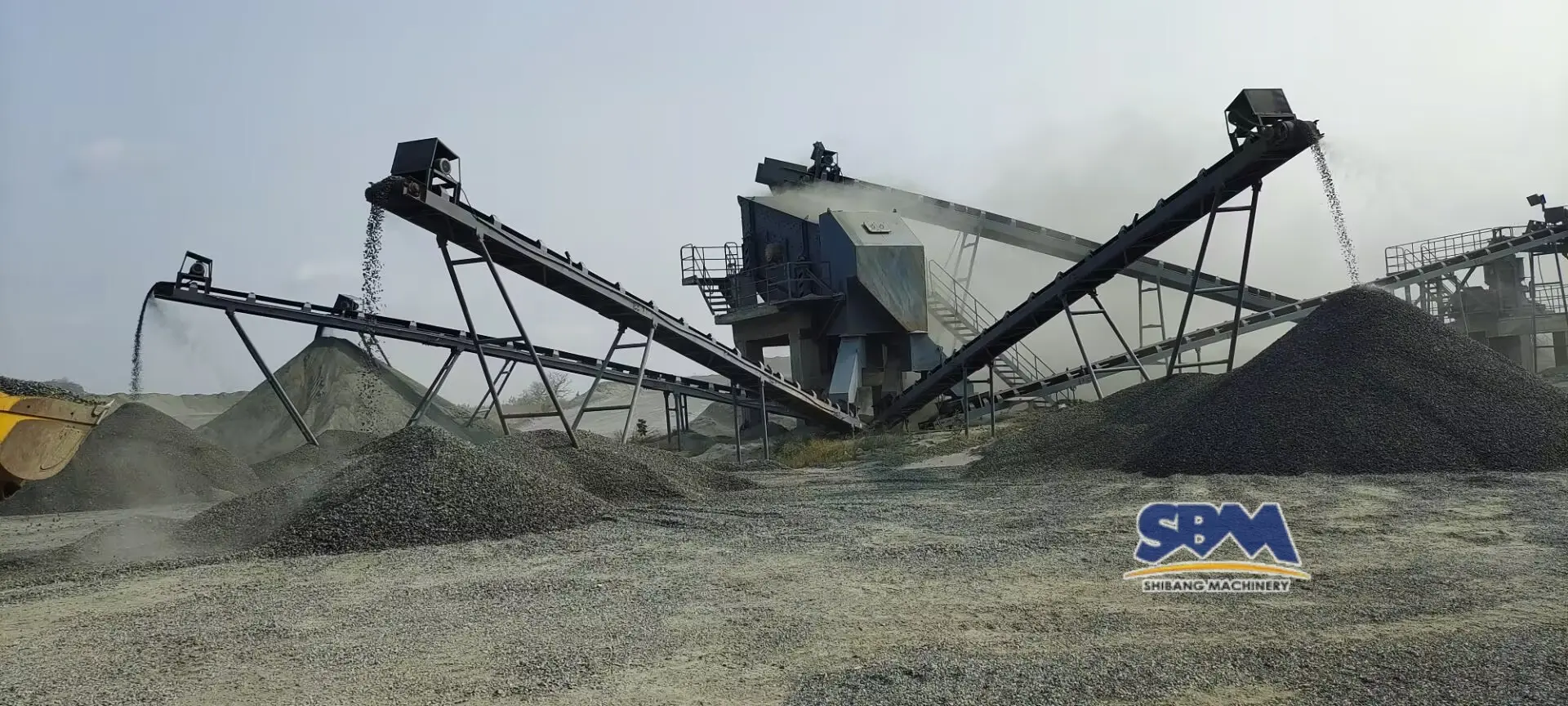
Many granite crushing plants still rely on manual checks, operator “feel” and end‑of‑shift reports. That often leads to unstable capacity, late reaction to problems and avoidable breakdowns. At the same time, AI and automation are rapidly entering crushing, screening and quarry operations worldwide, helping plants run closer to their optimum, 24/7. This guide explains how to apply AI granite crushing plant (PE jaw + cone + screens + maybe VSI), what problems it can solve, and how to start without over‑complicating your operation.
What Problems AI Can Solve in Granite Crushing Plants?
Typical pain points where AI/automation helps:
- Unstable capacity and product quality – plant only runs at “sweet spot” when the best operator is on shift.
- Unplanned downtime – jaw or cone suddenly fails; root cause was invisible until it was too late.
- Manual, slow monitoring – parameters checked infrequently, issues discovered hours after they started.
- Labor and skills shortage – hard to find and keep experienced crusher operators, especially for remote granite quarries.
AI‑enabled systems use sensors, cameras and control logic to continuously watch the plant, learn what “good” looks like, and automatically adjust or warn before things go wrong.
Layer 1: Real-Time Monitoring and Analytics
The first layer is “visible”: digitizing key data to let you know the status of the granite line at any time.
What to monitor?
- Crusher load, power draw, CSS position, hydraulic pressures.
- Vibration and temperature on jaw, cone and key bearings.
- Conveyor speeds, belt tracking, blockages.
- Product size and gradation using belt cameras + computer vision.
- Dust, noise and emissions for compliance dashboards.
How AI helps here?
- Computer vision systems measure rock size distribution on belts in real time, revealing subtle changes in jaw or cone performance long before a failure.
- Dashboards and alerts highlight abnormal patterns (e.g., rising power draw, coarser product, unusual vibration) and notify operators immediately instead of after a shift.
This layer itself can reduce blind spots and turn “management based on feelings” into “management based on data.”
Layer 2: AI Optimization of Jaw, Cone and Screening
The second layer is “automatic tuning”: AI not only looks at the data, but also helps you adjust parameters to make the granite line run closer to the optimal state.
Examples from the industry
- The AI model automatically adjusts the crusher speed, CSS, feed volume and screening parameters based on real-time data, allowing crushing and screening to find a balance between target output, particle size and energy consumption.
- Digital twins and AI control can test different working conditions through simulation, and then send the optimal parameters to the on-site control system.
Practical impact in a granite line
- Jaw crusher: maintain optimal feed level and toggle/jaw settings to avoid both choking and starving.
- Cone crusher: adjust CSS and speed to keep power draw in the “sweet zone”, controlling fines and maximizing throughput.
- Screens: tune speed and angle to reduce recirculation and ensure ballast aggregate / highway aggregate / concrete aggregate specs.
The result is: the same PE jaw crusher + cone + screening configuration, with the assistance of AI, can often achieve more stable ton output, better particle shape and lower kWh/t.
Layer 3: Predictive Maintenance for Granite Crushers
The third layer is “accurate calculation”: not waiting to repair the equipment before it breaks down, but detecting signs in advance to achieve true predictive maintenance.
How it works?
- The sensor continuously collects vibration, temperature, pressure, load and other data.
- AI/ML models learn data patterns in healthy states and identify deviation trends.
- Issue early warnings when early abnormalities occur (such as problems with bearings, gears, liners, and shafting) and arrange planned shutdowns for maintenance instead of being forced to shut down production for repairs.
Real cases show that AI-driven predictive maintenance can increase crusher availability to nearly 99.9%, achieve zero unplanned downtime in a year, and detect hundreds of fault signs in advance.
What this means for granite plants?
- Granite is hard and abrasive, and crushers are prone to major repairs due to wear or fatigue under such working conditions; predictive maintenance can significantly reduce major accidents.
- Fewer unexpected shutdowns mean actual output is closer to design values and costs per ton are more controllable.
- The maintenance team can schedule production as planned instead of reacting to “another sudden shutdown today.”
Layer 4: Smart Quarry Integration – Beyond the Crusher
Looking further up, AI can not only manage a crusher, but also an entire granite quarry and aggregate base.
- Autonomous or semi-autonomous haul trucks:Use AI and sensors to optimize distance, speed, and queue times to increase truck turnover and alleviate driver shortages.
- Smart quarry platforms:Summarize crushing, screening, transportation and other data into one platform, and use algorithms to identify bottlenecks, optimize scheduling, and plan for production expansion.
- AI environmental monitoring:Automatically analyze dust, noise, and emissions data and generate reports to meet regulatory and ESG disclosure requirements.
How to Start with AI in a Granite Crushing Plant (Without Over-Complicating)?
Many bosses are concerned: “It sounds high-end, but will it be too complicated and expensive?” You can give a step-by-step idea:
- Start with data collection and visualization
- First install basic sensors and cameras on key equipment for real-time monitoring + simple alarm.
- Introducing local AI capabilities
- For example, if it is first applied to “granularity online detection” or “conveyor belt/large foreign matter detection”, the effect will be immediate (reduce blockages and major failures).
- Extended to predictive maintenance and automatic tuning
- After accumulating data for a period of time, a service provider or system integrator specializing in mining/crushing equipment AI is introduced to create predictive maintenance and process optimization models.
- Finally consider smart quarries and fleet automation
- When the crushing line itself matures digitally, it will be expanded to transportation, loading, dispatching and other links to form a true “Smart Granite Quarry”.
This rhythm not only reduces the cost of trial and error, but also makes it easier for you to sell different levels of digital/intelligent solutions at different stages.
FAQs – AI and Smart Monitoring in Granite Crushing Plants
1. Do I need fast internet for AI in my granite crushing plant?
Not necessarily. Many AI systems for rock size analysis and predictive maintenance run on edge devices locally, processing camera and sensor data on site without constant cloud connectivity, then syncing summaries to your central systems when possible.
2. Is AI only suitable for very large, high-budget granite quarries?
Large operations are early adopters, but smaller plants can also benefit from focused AI use cases such as belt big‑rock detection, online gradation measurement or simple predictive maintenance modules. Many vendors now offer modular solutions that can be scaled up over time.
3. How quickly can AI-based predictive maintenance pay back in a granite plant?
Case studies in mining and heavy industry show that avoiding just a few major crusher breakdowns and associated downtime can pay back the system within a relatively short period, especially when crushers are high‑value assets and production stoppages are expensive.