Email: [email protected]


As river sand becomes more expensive and restricted, many producers and contractors are switching to granite manufactured sand (M‑sand). But engineers and project owners often worry: will granite M‑sand affect workability, strength, or long‑term durability compared with familiar river sand? This article compares granite M‑sand and natural river sand from a practical, project‑oriented perspective: quality, mix design, cost and risks.
What Is Granite M‑Sand vs River Sand?
- Granite M‑sand (manufactured sand)
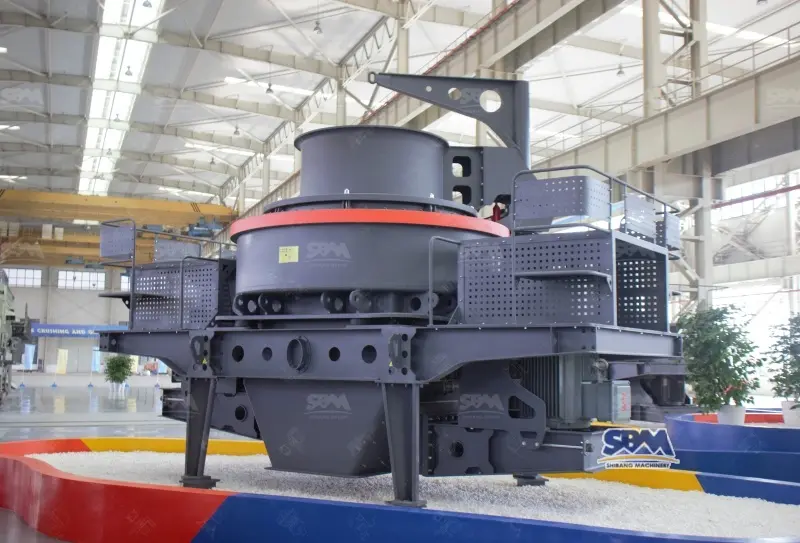
- Produced by crushing and shaping granite with crushers + sand making machines (usually VSI).
- Particle size typically 0–4.75 mm, with controlled gradation and shape.
- River sand (natural sand)
- Naturally occurring sand collected from riverbeds or pits.
- Particle shape tends to be more rounded; gradation depends on source and washing.
Related contents:
Key Technical Differences: Shape, Gradation and Fines
Particle shape
- Granite M‑sand:
- More angular, often cubical when produced with VSI; rougher surface texture.
- Better mechanical interlock and bond with cement/bitumen, but its fluidity during mixing is slightly inferior to that of smooth river sand.
- River sand:
- More rounded and smooth; improves workability and pumpability.
- Bond strength may be slightly lower if particles are too smooth or contaminated with silt/clay。
Gradation (size distribution)
- Granite M‑sand:
- Can be engineered to fit specific gradation curves by adjusting crushers, screens and classifiers。
- It offers better stability and is suitable for long-term supply to large-scale ready-mixed concrete and asphalt plants.
- River sand:
- Gradation often varies from batch to batch, depending on source and season。
- Frequent testing and adjustments to the mix proportions are required to maintain stable performance.
Fines content
- Granite M‑sand:
- It tends to produce a lot of stone powder, and the content of fine powder <75 µm needs to be controlled through sand washing or grading.
- Some stone powder can be beneficial to concrete within a certain range (filling effect), but excessive amounts will affect water demand and shrinkage.
- River sand:
- It may contain mud, silt, clay and organic matter, which can affect its strength and durability.
- The mud content and harmful substances need to be controlled through sand washing and testing.
Performance in Concrete and Asphalt
In concrete
Granite M‑sand – Advantages:
- High-strength aggregates, combined with a reasonable gradation, can achieve excellent compressive strength.
- The particles have distinct edges and corners, which improves the interlocking force and shear resistance between aggregates.
- Controllable gradation is beneficial for factory-scale production of ready-mixed concrete.
Please note:
- Slightly less fluid than river sand, it requires adjustments through mix design: adding water-reducing agents, optimizing the sand ratio, etc.
- Control the stone powder content within the limits allowed by specifications or design.
River sand – Advantages:
- It has good workability, and its ease of use and pumpability are generally good.
- It is more “familiar” to the construction team, and they are more psychologically accepting of it.
Question:
- Resources are becoming increasingly scarce, and prices are high and highly volatile.
- The quality and gradation are unstable, and the risk of mud and impurities is relatively high.
In asphalt and highway layers
Granite M‑sand:
- When used with granite coarse aggregate, it provides good anti-skid and wear-resistant properties.
- Particle shape and stone powder content can be precisely controlled according to the asphalt mixture design (such as SMA, AC).
River sand:
- It is mostly used in localized or economically feasible areas; in many high-grade highway and airport projects, manufactured sand + manufactured crushed stone has gradually become the mainstream.
How can these performance requirements be met through equipment and processes? Related content:
Cost and Supply Considerations
From the perspective of projects and owners, cost and supply stability are often more sensitive factors than purely technical differences.
- Granite M‑sand
- Initially, investment is required for a crushing and sand making line, but once completed, both output and quality are controllable.
- In many regions, the cost per ton can be significantly lower than relying on external river sand purchases in the long term; at the same time, it reduces transportation radius and carbon emissions.
- River sand
- Procurement prices are greatly affected by seasonality, policy, and resource constraints.
- In areas where river sand mining is strictly controlled, the risks of supply disruption and administrative risks are both high.
Therefore, for long-term projects or ready-mixed concrete/asphalt companies, setting up granite manufactured sand production lines is often an important means of “locking in costs and ensuring supply security”.
When Should You Prefer Granite M‑Sand? And When River Sand Is Acceptable?
More suitable for using Granite M-sand
- You own or have access to a stable supply of granite and a crushing production line.
- Projects with long cycles and large quantities (such as commercial concrete mixing plants and highway aggregate bases).
- Local authorities impose strict restrictions on river sand mining, or the transportation distances are long and the prices are high.
- They have high requirements for quality and traceability and hope to control quality through factory production.
Some suitable for using River sand
- For small, short-term projects with limited usage, building your own cabling is not cost-effective.
- There are still sufficient river sand resources in the area, with controllable quality and reasonable prices.
- They have a high tolerance for later supply risks and price fluctuations.
If you already have a granite crushing line, you can enter the M-sand business simply by adding sand making and washing equipment.
How to Transition from River Sand to Granite M‑Sand?
Many practical problems lie in the “transition period”: how to transition from pure river sand to partially or entirely manufactured sand without causing large-scale quality problems and complaints.
Suggested steps:
- Laboratory comparative test
- Concrete samples were prepared using local river sand and the proposed granite M-sand, and their strength, workability, and durability were compared.
- Progressive replacement
- First, partially replace river sand (e.g., 20–50%) in ordinary strength grade or non-critical components, and observe the construction and hardening effects.
- After accumulating experience, the usage rate can be increased in higher-level or key areas.
- Optimize mix proportions and admixtures
- Adjust the sand ratio, water-cement ratio, and admixture dosage according to the particle shape and fineness modulus of M-sand.
- Communicating with the owner and supervisor
- Submit test reports and technical specifications in advance to obtain approval from the designer, supervisor, and owner, thus avoiding on-site disputes.
Related Content:
FAQs – Granite M‑Sand vs River Sand
1. Will using granite M‑sand reduce concrete strength compared with river sand?
Not if it is produced and graded correctly. With proper control of particle size, shape and fines content, granite M‑sand can match or exceed the compressive strength of concrete made with river sand. Any differences are usually handled through mix design adjustments rather than being inherent weaknesses.
2. Why does concrete with granite M‑sand sometimes feel less workable than with river sand?
Granite M‑sand particles are more angular and have rougher surfaces than rounded river sand, which can increase water demand and reduce flow. This can be compensated by optimizing gradation, adjusting sand content and using suitable water‑reducing admixtures to restore or improve workability.
3. Can I mix granite M‑sand and river sand in the same concrete mix?
Yes. Many producers use a combination of M‑sand and river sand to balance workability, strength and cost. The exact proportion should be determined through trial mixes and testing, but blending often offers a smooth transition when shifting from full river sand to higher shares of manufactured sand.