Email: [email protected]


For hard, highly abrasive rock (granite, basalt, quartz‑rich ores), a jaw crusher is the better choice for primary crushing, while impact crushers are generally not recommended as the main machine.
When to use a jaw crusher?
- Jaw crushers use compression and are designed specifically to handle very hard, tough materials like granite, basalt and hard ores at the primary stage.
- They accept large feed sizes, have high throughput and lower wear costs in abrasive hard rock compared with impact crushers, though the product is coarser and more flaky.
When (and how) to use an impact crusher?
- Impact crushers rely on high‑speed impact and are best for medium‑hard to soft, less abrasive rock such as limestone, clay, and many recycled materials, where they give excellent cubic shape and high reduction ratio.
- Using an impact crusher as the main machine on very hard, abrasive rock quickly wears blow bars and liners, sharply increasing wear‑part cost and downtime; if used, it is usually as a secondary/tertiary stage after a jaw or cone to improve shape.
Hard rock choice summary
| Aspect | Jaw crusher (hard rock) | Impact crusher (hard rock) |
|---|---|---|
| Crushing principle | Compression between fixed and moving jaws | High‑speed blow bars against impact plates |
| Suitable materials | Very hard, abrasive (granite, basalt, ores) | Generally medium‑hard, less abrasive; hard rock only in selected cases with high wear |
| Typical position | Primary crusher in hard rock plants | Secondary/tertiary or shaping, not main primary for very hard rock |
| Product shape | Coarser, more flaky, less cubic | Very cubic, good gradation |
| Wear and OPEX in hard rock | Lower wear cost, more economical in abrasive rock | High wear rate and higher cost per ton in abrasive rock |
Recommended Crusher Combinations
| Rock type & hardness | Max feed (mm) | Capacity target (t/h) | Main product size (mm) | Recommended SBM configuration | Model‑level notes |
|---|---|---|---|---|---|
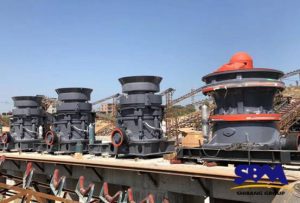
| Granite / basalt (very hard) | 600–700 | 120–180 | 0–31.5 | Primary: PE600×900 / PE750×1060 jaw + Secondary: HST160 cone + Tertiary: HST160 (short head) if needed | PE‑series jaws are suitable for primary crushing of hard rocks like granite and basalt; HST160 handles hard rock secondary/tertiary with high efficiency. |
| Granite / basalt (high‑capacity plant) | 700–900 | 250–400 | 0–25 | Primary: PE900×1200 jaw + Secondary: HPT300 multi‑cylinder cone + Tertiary: HPT300 / HPT400 | Large PE jaws accept big feed; HPT cones are recommended by SBM for hard‑rock mining with high throughput and lower operating cost. |
| Hard quartzite / iron ore | 500–650 | 180–260 | 10–40 | Primary: PE750×1060 jaw + Secondary: HST250 cone | Deep‑chamber PE jaws from SBM are designed for harsh rocks and industrial minerals; HST250 gives precise CSS control for 10–40 mm products. |
| Gneiss / hard sandstone | 350–500 | 100–180 | 0–20 | Primary: PE600×900 jaw + Secondary: HST160 cone + Shaping: CI5X impact (optional) | Jaw + HST160 do main reduction; CI5X impactor is used only as a shaping stage to boost cubicity where needed. |
| Medium‑hard limestone | 500–700 | 180–280 | 0–25 | Primary: PE750×1060 jaw or CI5X primary impact + Secondary: CI5X impact | For limestone, SBM often uses impact crushers as key machines; CI5X series provides high reduction and good shape for aggregates. |
| Medium‑hard limestone (finer products) | 300–450 | 80–150 | 0–10 | Single‑stage CI5X impact or two‑stage CI5X in closed circuit with screen | CI5X impact crusher is described as efficient, low‑cost equipment for medium‑hard rock and aggregates, suitable for high‑fines production. |
| Dolomite / soft sandstone | 250–400 | 70–130 | 5–25 | Primary: PE500×750 jaw + Secondary: CI5X impact | PE500×750 has a 425 mm max feed and 45–100 t/h capacity, ideal as a compact primary; CI5X secondary impact refines to 5–25 mm. |
| River pebble / gravel (abrasive) | 300–500 | 120–200 | 0–20 | Primary: PE600×900 jaw + Secondary: HST160 cone + Optional VSI6X for shaping | Jaw + HST160 handle abrasive pebbles; VSI‑type or similar vertical‑shaft impactor from SBM is added only for final shaping and sand. |
| Soft limestone / marl | 400–600 | 80–150 | 0–31.5 | Single CI5X impact with vibrating screen | For soft, low‑abrasive limestone, SBM recommends impact‑centric lines; one CI5X can act as primary and secondary in a compact plant. |
| Recycled concrete with rebar | 400–600 | 80–150 | 0–32 | Primary: PE600×900 jaw + Secondary: CI5X impact | PE jaw handles rebar and big blocks; CI5X improves particle shape for recycled aggregate in base and concrete. |
| Asphalt millings / RAP | ≤300 (pre‑milled) | 80–150 | 0–16 | Single CI5X impact in closed circuit | Impact crusher is suitable for asphalt and similar soft–medium materials, with adjustable rotor speed and curtain gaps. |
| Mixed C&D waste (concrete, brick) | 300–500 | 80–150 | 0–40 | Primary: PE500×750 or PE600×900 jaw + Secondary: CI5X impact | Compact PE jaw as first breaker; CI5X secondary for controlled size and better gradation; presorting system recommended. |
Recommended 50–100 t/h Crushing Plant
| Capacity range(≈50–100 t/h) | Rock type & hardness | Max feed (mm) | Target product (mm) | Suggested configuration (SBM‑style) | Notes |
|---|---|---|---|---|---|
| Small hard‑rock quarry | Granite / basalt (hard) | 350–450 | 0–25 | Primary: PE500×750 jaw + Secondary: HST100 / small cone | PE500×750 (45–100 t/h) is a classic small primary; HST100 cone refines to 0–25 mm for concrete aggregates. |
| Hard sandstone / gneiss | Hard, moderately abrasive | 300–400 | 0–20 | Primary: PE400×600 / PE500×750 jaw + Secondary: HST100 cone | Compact jaw plus single‑cylinder cone suits small quarry lines in the 60–90 t/h band. |
| Medium‑hard limestone | Medium hardness, low abrasion | 300–400 | 0–25 | Single CI5X impact or primary PE400×600 + CI5X impact | For softer limestone, small CI5X impactor can do primary+secondary; jaw is optional if feed is blocky. |
| Dolomite / soft sandstone | Medium | 250–350 | 5–25 | Primary: PE400×600 / PE500×750 jaw + Secondary: CI5X impact | Jaw gives control on feed size; CI5X provides cubic aggregates at modest wear cost in this capacity range. |
| Small C&D / concrete recycling | Concrete with rebar | 250–350 | 0–32 | Primary: PE400×600 / PE500×750 jaw + Secondary: small CI5X impact | Jaw removes rebar and big lumps; secondary impact improves shape and liberates mortar at 50–100 t/h. |
Recommended 100–200 t/h Crushing Plant
| Capacity range(≈100–200 t/h) | Rock type & hardness | Max feed (mm) | Target product (mm) | Suggested configuration (SBM‑style) | Notes |
|---|---|---|---|---|---|
| Standard hard‑rock plant | Granite / basalt (very hard) | 500–650 | 0–31.5 | Primary: PE600×900 / PE750×1060 jaw + Secondary: HST160 cone | PE600×900 and PE750×1060 cover 80–180 t/h; HST160 cone as secondary suits 10–40 mm output for base and concrete. |
| High‑quality concrete aggregate | Granite / gneiss | 450–600 | 0–25 | Primary: PE750×1060 jaw + Secondary: HPT200 / HPT300 cone | HPT multi‑cylinder cones are positioned for high‑quality aggregates; in 150–200 t/h they give good shape and throughput. |
| 200 t/h limestone line | Medium‑hard limestone | 500–700 | 0–5 / 5–10 / 10–31.5 | Primary: PE750×1060 or CI5X primary impact + Secondary: CI5X impact + Vibrating screens | SBM 200 t/h limestone cases use primary + secondary impact with multi‑fraction screens for 0–5, 5–10, 10–31.5 mm. |
| River pebble / gravel | Hard, abrasive | 350–500 | 0–20 | Primary: PE600×900 jaw + Secondary: HST160 cone + Optional VSI6X shaping | Jaw + cone handle abrasion; VSI‑type stage is added only where sand and extra cubicity are required. |
| Recycled concrete & asphalt | Medium hardness | 350–500 | 0–25 / 0–32 | Primary: PE600×900 jaw + Secondary: CI5X impact (closed circuit) | 100–200 t/h mobile or stationary recycling lines often use jaw + HSI to balance throughput and product quality. |
Recommended 200–400 t/h Crushing Plant
| Capacity range(≈200–400 t/h) | Rock type & hardness | Max feed (mm) | Target product (mm) | Suggested configuration (SBM‑style) | Notes |
|---|---|---|---|---|---|
| Large hard‑rock quarry | Granite / basalt (very hard) | 650–900 | 0–25 / 0–31.5 | Primary: PE900×1200 / C6X110 jaw + Secondary: HPT300 / HPT400 cone + Tertiary: HPT300 short‑head if needed | C6X/large PE jaws are used for 200–400 t/h primary; HPT cones recommended by SBM for large hard‑rock mining and aggregates. |
| High‑spec asphalt & concrete | Hard rock (granite, gneiss) | 600–800 | 0–20 | Primary: C6X110 jaw + Secondary: HPT300 cone + Shaping: VSI6X or CI5X impact | Jaw + multi‑cylinder cone provide grading; final shaping stage improves flakiness index for premium asphalt mixes. |
| 300–350 t/h limestone plant | Medium‑hard limestone | 600–800 | 0–5 / 5–10 / 10–20 / 20–31.5 | Primary: PE900×1200 or C6X110 jaw + Secondary: CI5X impact + Tertiary: CI5X / VSI6X sand maker | Larger limestone lines in SBM cases use jaw + 2–stage impact or impact + VSI for multiple aggregate fractions and machine‑made sand. |
| Large river pebble / hard gravel | Hard, highly abrasive | 400–600 | 0–25 | Primary: C6X100 / C6X110 jaw + Secondary: HST250 / HPT300 cone + Optional VSI6X | Emphasis on robust C6X jaw and wear‑optimized cone for 200–350 t/h; VSI used only where sand demand is high. |
| High‑volume C&D / concrete recycling | Mixed concrete, brick, asphalt | 400–600 | 0–32 | Primary: C6X100 / PE900×1200 jaw + Secondary: CI5X impact (2 units in parallel if needed) | For 250–350 t/h recycling hubs, one large jaw feeds one or two CI5X impactors in closed circuit with multi‑deck screens. |
Please tell us a bit about your project – material type, maximum feed size, required capacity, target product size, and any site or terrain limitations. Based on this information, our engineers will quickly recommend the most suitable crushers and a complete solution tailored to your needs.
You can contact us at any time, and our team will get back to you as soon as possible with a clear proposal and quotation.
FAQ: Jaw Crusher vs Impact Crusher
Q1: How do I choose between a jaw crusher and an impact crusher for my material?
A1: The choice mainly depends on material hardness, abrasiveness, and your product size requirements. For very hard, abrasive rock (granite, basalt, quartz), a jaw crusher is usually the best primary machine, often followed by a cone crusher. For medium‑hard or softer, less abrasive materials (limestone, construction waste, asphalt), an impact crusher is ideal for achieving high reduction ratios and good particle shape.
Q2: What information do you need to recommend a suitable crushing solution?
A2: To recommend the right configuration, it is important to know: material type and hardness, maximum feed size, required production capacity (t/h), desired product size range, and any site or mobility constraints. With these details, engineers can match appropriate jaw, cone, and impact crusher models and design a complete, efficient process flow.
Q3: Can one crusher type handle both hard rock and construction waste?
A3: In most cases, a single crusher type cannot work optimally for both extreme hard rock and mixed construction waste. For hard rock, a jaw‑and‑cone combination is usually preferred for durability and lower wear costs. For construction and demolition recycling, a jaw plus impact crusher setup (or a primary impactor) is typically more efficient for handling rebar, producing better‑shaped recycled aggregates, and meeting road base or concrete specifications.